Monday, December 02, 2024

Another perspective on the Dyurrite/Mount Arapiles debate

 I’m sharing this commentary by climber Keith Bell who arguably has more credibility than most who have been involved in the current hysteria around the climbing restrictions at Dyurrite/Mount Arapiles. Keith’s observations mirror my own and I am sure many others whose voices have been drowned out by the shrill voices of those who claim to represent Australian climbers. They don’t represent me nor many of my contemporaries and I, like others, find their most recent appeals to the political fringe — a cohort of climate deniers, environmental vandals and obstructionists to First Nations legal rights — insulting and offensive. They assert a mistaken belief that climbers are somehow ‘special’ with rights of access that transcend Australian law. What arrogance! Here’s what Keith had to say…


The Arapiles Declaration

Some Thoughts


In recent years there has been a tendency to transpose the artificial and synthetic surroundings of the climbing gyms onto the living, natural rock. Associated with this process has been grid bolting and the widespread use of chalk on our beautifully hued rock. This process was always going to be eventually noticed by land managers, First Nations Peoples and others.


And so, enter the ban on Gariwerd by Parks Victoria, its literature on the matter always quickly referring to the detrimental effects on the rock and environment by the placing of Bolts and the use of Chalk.


How did climbers respond? We came up with all manner of excuses, reasons and deflections why we should keep on doing exactly what we were doing. We manned the parapet, threw grenades, fired the occasional mortar round but were blitzed by the heavy artillery that any government department is armed with.


It seemed to me we were represented by the ‘bolt and chalk’ brigade with a few other representatives who were rude, officious, and abrasive – and that is to their fellow climbers.


So along comes the ban on Dyuritte.


Same climbers, same representatives but at least they have been joined by more reasonable folk. Petitions, letters to Parliamentarians and papers, radio, TV, meetings - all the standard fare. 


Then they, ‘the ironclad committee’ come up with a real brain wave – the ultimate strike weapon.

Let’s go nuclear!

And who better to enlist in this endeavour, than the Federal LNP opposition. 


So now we have the Arapiles Declaration, they did not even have the decency and respect to use the First Nations name. Alarmingly, the climbers involved did not care to run it past their fellow climbers before proceeding down this path. 


On the two Facebook post that I have seen so far there has been great jubilation, back-slapping, congratulations and acceptance by fellow climbers.


But this is a toxic and radioactive document. While Arapiles is mentioned the wide-ranging ambit of this manifesto is to neuter, reject or repeal Mabo and First Nations Legislation.


The LNP after scuppering the gentle request of the Voice is now going after the above in the guise of helping climbers.


This is a disgraceful document with disgraceful intent. I want nothing whatsoever to do with it. I’m sure that there are other fair-minded and reasonable climbers who are also likewise offended by this brazen, political opportunism. 


We have 60 years of history at the crag, First Nations People have millennia. Their love of country is great – ours is fleeting. There are already climbers stating that they are going to leave if they cannot climb.


Perhaps at the start of this we climbers could have got off our high horses and negotiated on the obvious things that we need to do to ameliorate the bolt and chalk situation. I think that this is only the start of such interludes – we had better learn to get this right.


Finally, be careful what you wish for if you support this document. You might well find that your favourite crag is destined to be mined or quarried.

Friday, June 28, 2024

From the vault... July, 1960

Jon Stephenson the 1st Australian to climb to 7000 metres without supplementary oxygen


Jon Stephenson began his passion for the outdoors as a founding member of the University of Queensland Bush Walking Club (UQBWC) in 1949. He applied his scientific bent to research and exploration on his beloved Mount Barney (his PhD thesis), the Antarctic and the Himalayas amongst other iconic destinations. With colleague Ken Blaiklock, Jon became the first to drive a dog team to the South Pole since Raold Amundsen in 1911. He later published a book documenting his Antarctic exploration - Crevasse Roulette: the first trans-Antarctic crossing 1957-1958.

My reason for revisiting Jon's extraordinary 1960 achievement in the Himalayas was triggered by a recent catch-up with two of his longtime pioneering colleagues, Peter Barnes, 95, and Alan Frost, 89. They shared countless climbing experiences from 1949, including a long list of first ascents around southeast Queensland. Although Peter's outdoor exploits have been slowed by impaired vision, his passion for the outdoors remains unbridled. Alan is active and still regularly climbs Mount Barney, almost always up his favourite ascent route, Logan's Ridge (around 150 ascents so far). 

Peter passed on to me a letter and photographs Jon had sent to him in 2010, documenting Jon's attempt to climb K12 (7428 metres) in the Karakoram mountains whilst on a scientific expedition there over a three-month period in mid-1960. Jon had organised the expedition - the Saltoro Expedition 1960 - with another UQBWC protege, Keith Miller who, three years earlier, had travelled in the area with the doyen of Himalayan exploration, Eric Shipton, and a group of students from Imperial College in London. As Jon observed, 'Keith thought it would be a good idea to climb the mountain K12'. 


Keith Miller contemplates a vertical granite wall on the Grachmo Glacier,
close to the base camp used by the Saltoro expedition to the Karakoram in 1960. Photo: Jon Stephenson

With two other colleagues, David Haffner and Jim Hurley, they flew into Skardu in the Kashmir region and trekked into the Karakoram with 100 porters and a Pakistani liaison officer. Sadly, Keith became ill on the expedition and was forced to go home early. He later distinguished himself in further Karakoram exploration and in Arctic scientific endeavour for which he was awarded a Royal Geographical Society medal. 

Sunset on K12 with the ascent route up the right hand skyline. Photo: Jon Stephenson


On 5 July, Jon was snowbound in a tent, high on the slopes of K12 with a Balti porter, Mohammed Choo, the only one willing to accompany him on his summit attempt. They had climbed through an icefall and up a 'straightforward' ridge, setting up a campsite on the crown of the rock ridge about one-third of the way up the mountain. The next morning, they continued, traversing above a line of huge ice cliffs. It was relatively easy going up moderate snow slopes towards a ridge which led to the summit. It was then that Choo became ill. Despite climbing without supplementary oxygen, Jon was in good condition and decided to climb on alone, leaving Choo to recover on a ledge cut out of the snow slope. Jon takes up the story:

"There was nothing to stop me except my own condition. Approaching the isolated rocks above the higher ridge promontory, about 10 per cent below the summit, I simply could not proceed, except with great slowness and deep shortage of breath. I might eventually have reached the summit, but would have spent the night out. Besides, I had to descend to see how Choo was faring. So I descended, much more easily, joined him, and climbed down to our tent without falling over the ice cliffs! The descent to the saddle was without incident the next morning...for a few years I harboured an ambition to make a return expedition. Fortunately this idea went away. It needed money!"


Looking across an ocean of summits towards the highest, K2, from the north ridge of K12. Jon wrote that he could see the curvature of the earth from his vantage point. Photo: Jon Stephenson


Looking north from K12 to the towering Saltoro Kangri (7742 metres) above the Bilafond (Butterfly) Glacier, used by the expedition team to access its tributary, the Grachmo Glacier. Photo: Jon Stephenson.

Jon Stephenson had climbed to 7000 metres and with no supplementary oxygen - the first Australian to do so. It was 6 July, 1960, the same day that an American duo, George Irving Bell and Willi Unsoeld, made the first ascent of nearby Masherbrum (7821 metres). 

Jon later established the Department of Earth Sciences at James Cook University in North Queensland and worked there as Professor of Geology 1970-1995. He was amongst the first to warn of the dangers of climate change based on his extensive scientific exploration and research over decades. He died aged 80 in Townsville on 24 May,  2011.


Many thanks to Peter Barnes for this historic material.


About The Living Rock...


 The Dugandan -- 1998

(from left) Bryden Cais, Greg Sheard, Ian Thomas, Paula McCall (partly obscured), unknown, Celia and Chris Thompson, Wendy Steele (at end of table), Scott Stewart, Trish Hindmarsh, Keith Harper, Carola Henley and Ted Cais. Photo: Michael Meadows

THIS JOURNEY into Australian rockclimbing history began (above) on a warm Winter's afternoon in 1998 at the Dugandan Hotel, near Boonah. I was sitting around a table on the veranda of the pub with a group of friends, climbers, young and old. My school friends Greg Sheard and Ian Thomas were there as was Ted Cais with his son, Bryden. Ted and Bryden were visiting for another stint of climbing at nearby Frog Buttress from Ted's new home in the United States. Greg tossed a copy of Rick White's original climbing guide to the crag onto the table and the young climbers present pored over it as if it was the Holy Grail. It was clear that they valued this moment and the apparently insignificant, hand-stapled collection of words and images. It may have been at that moment that I realised that it was far more than a rockclimbing guide: it represented a historical moment in the origins of climbing in Queensland -- and beyond.

A defining feature of many of the crags that have become so attractive to climbers in Queensland and elsewhere in Australia is the presence of vegetation in multifarious forms — from the smallest algae and lichen to tenacious shrubs and even large trees. This ‘living rock’ is a central feature of Queensland climbing, particularly on the low-angled cliffs where Queensland climbing culture was invented. It is ‘living rock’ in another sense as well, defining the relationship between climbers and the vertical world we temporarily inhabit.
 
Mountaineer and former Italian Vice-Consul in Brisbane in the early postwar period, Felice Benuzzi, identified an element of this ‘Australian-ness’ in his vivid descriptions of climbing and the environment in the Glass House Mountains, north of the city. Felice had contacted the inimitable ‘spiritual father’ of Queensland climbing, Bert Salmon, who took the diplomat on several ascents in southeast Queensland in 1952. Following a climb up Caves Route on Tibrogargan, Felice and Bert were walking back to their car through a forest of Eucalypts. Oblivious to 60,000 years of Indigenous culture, the Italian diplomat mused on the Australian environment:

The huge smooth trunks of the trees don’t recall images of cathedrals or columns of ancient temples, even though the colour could perhaps evoke something like marble and travertine. The thought repudiates such comparisons. They just don’t hold up. They’re out of key in this world that seems lacking in history. Yet Bertie, who was born and who has lived here, doesn’t seem to feel this sense of vacuum, of emptiness; this lack of something that is so difficult to express. I don’t dare to confess to him my thoughts for fear of offending him. He loves this forest; he loves this Australia with a devotion of a son.

This particularly Eurocentric attitude was commonplace in 1950s Australia and yet it lingers today. Every aspect of landscape was inscribed into Indigenous cultures eons before First Nations people ‘discovered’ Europeans. Some have suggested that it is this unique, rich cultural heritage that should influence how we ‘imagine’ our own idea of climbing in Australia. It is anything but the ‘sense of vacuum’ that Felice Benuzzi described albeit this parallel world remains largely invisible to most non-Indigenous Australians. 

In the early 1990s, an influential figure in Australian rockclimbing history, John Ewbank, evoked the spiritual relationship between people and landscape by drawing on Indigenous concepts. He argued that the elements that make a particular location ‘sacred’ for Indigenous people — ritual, belief and tradition — should also be central to understanding Australian rockclimbing culture. While acknowledging the clear differences in interpretation and meaning between Indigenous and non-Indigenous cosmologies, he suggests an analogy: that the act of climbing can be seen as ‘turning a piece of rock into a sacred site’ and ‘it is then that we superimpose special values on it, even if these values are comprehensible only to other climbers’. He concludes:

I think it is becoming increasingly important for climbers to see cliffs and mountains within the context of a broader landscape and to realise that these outcrops, these ‘bones of the planet’ are already sacred, just as they are to many people other than climbers. 

Sadly, ignorance and/or denial of a history of Indigenous custodianship of places that include climbing destinations has skewed recent public debate around access to crags. The ‘loudest voices’ seem to ignore the undeniable Indigenous heritage that has resulted in these places being preserved for our enjoyment. For some, it seems, less a century of regular climbing activity can override 60,000 years of Indigenous history. 

But apart from a lack of engagement with this philosophical question, a majority of climbers who have railed against restrictions on access to ‘their’ crags do not seem to understand that it is Australian law that they are now challenging. The 1992 High Court Mabo decision effectively destroyed the legal fiction that Australia was an empty land — terra nullius — at the time of European invasion in 1788. The High Court decision — ratified in 1993 by the Australian Parliament — set up a framework for Indigenous land to be returned to the original custodians — in effect, a cohort of an estimated 250 different ‘countries’ (with 500 separate languages) at the time of European invasion. Despite popular media misrepresentations of the Native Title Act as some sort of ‘land grab’, the legislation was designed primarily to protect non-Indigenous property rights. In fact, the ‘land grab’ occurred at the time of European invasion and settlement.

Native Title claims are limited to vacant Crown land, waterways, and parks and reserves — and it is the latter that has created conflict with some members of the climbing community because it is where most climbing cliffs are found. It has taken decades, in some cases, for Indigenous people whose communities and economic structures were disrupted and destroyed by European invasion and settlement, to gather sufficient evidence to make a Native Title claim over a particular country — or what’s left of it. Once a claim is proven, under Australian law, the identified Traditional Owners have the right to maintain and protect sites, to use the land for hunting or ceremony, camp and live there, share in any proceeds generated by development of the land, and to have a say in land management and development.

This historical and legal context seems largely absent from the online climbing community discussions in recent years. What most don’t seem to understand that it is not ‘our’ land — it is Aboriginal land and the 1993 Native Title Act has inscribed that into Australian law. We have been trespassing — albeit for many, unwittingly — on Aboriginal land from the time the first Europeans began seeking out the heights. But the world has changed and as climbers, we must change with it and respect the rights of the Traditional Owners — and Australian law. 

Interestingly, there have been several instances of climbing cliffs developed on private land around the country — at least two in Queensland alone — where the owners have subsequently closed them down, refusing all access, mainly because of bad behaviour (loud voices, swearing, gates left open etc). Strangely, there have been no public outcries by climbers about these imposed restrictions to ‘save our summits’. Why not? Because we acknowledge private land ownership laws. Similarly, restrictions on climbing to iconic summits like Uluru and Balls Pyramid have largely been accepted — so why don’t we afford the same degree of respect and acceptance to Native Title holders who now have the same legal rights under the Native Title Act

On another level, sport climbing and its associated activities — placing bolts and the use of chalk — seems to have done a very good job of attracting unwanted attention by leaving permanent and semi-permanent markers on the landscape. To non-climbers — and the handful of those who have eschewed the use of these climbing ‘aids’ outdoors — it is evidence of disrespect, little different from defacing scenic areas with graffiti. Is this how climbers demonstrate ‘care’ for the environment? I have often wondered whether we would be even dealing with such issues now if the use of bolts and chalk 
— I am hopeful that wisdom, knowledge and good sense will prevail and that climbers and Traditional Owners will reach a compromise through genuine negotiation rather than confrontation or litigation to enable us all to share this amazing country by respecting these priceless resources. It is precisely this unique cultural heritage that sets Australian climbing culture apart from the rest of the world. So why not enlist Traditional Owners or their representatives to share creation stories of the places we visit; involve local Indigenous communities in existing (or new) climbing education and training activities and in the business structures that profit from access to these special areas; or incorporate local Indigenous cultures into climbing guides? 

We can do do better than we have done thus far. A lot better.


Tuesday, March 21, 2023

 Two Tassie summits and a classic climb


One for the surgeon: Ian 'Humzoo' Thomas testing out his recently-reconstructed knee 
on the classic climbing route, Apline - Whitewater Wall, Freycinet, March 2023


There has been a run of obituaries on this blog over past few months so I think it's time to celebrate the living. I had the great pleasure to travel extensively around Tasmania in March, 2023, with good friend and legendary climber, Ian 'Humzoo' Thomas. Ian had a knee reconstruction six weeks earlier and was keen to test it out on a few challenging summits - and the fabulous Whitewater Wall climbing route, Apline. His knee passed with flying colours.

The video embedded below captures our two summit climbs - Mount Victoria in northeast Tassie and Mount King William I in the southwest. It was a truly memorable journey and a testament to Ian's incredible persistence in re-discovering the fine physical form of his younger days. Our shared euphoria at seeing a cloud-free Frenchman's Cap - several times - with the southwest's extraordinary mountain landscape spread out before us was unforgettable. 

This is why we do it! 

The wonders and beauty of Tasmania's wild places are self-evident - it's the camaraderie and inevitable humour that always takes this to a new level.

Two Tassie Summits video (18:32)

Tuesday, January 31, 2023

Vale Will Steffen 1947-2023

Climate scientist, climber and climbing historian


Will Steffen (Photo courtesy Climate Council)


I didn't ever meet Will Steffen but I was aware of his extraordinary work in climate science and his perhaps lesser-known contributions to Australian climbing history. 


He became a resident of Canberra in 1977 when he moved from the US to take up a postdoctoral research position with the Australian National University (ANU). He spent 35 years exploring mountain regions of the world, rockclimbing and mountaineering on every continent except Antarctica. He was a member of the 1988 Australian Baruntse (7129 metres) Expedition, forced to retreat 100 vertical metres below the summit by dangerous snow conditions on a knife-edge ridge. An account of the expedition is available in The Himalayan Journal


Will had an abiding interest in Australian mountaineering, penning two surveys of Australian Himalayan climbing, along with profiles of prominent local mountaineers. His 2017 book, Himalayan Dreaming, is the most complete and best-researched document of Australian mountaineering, particularly on the heights in Asia. The book is available as a free download from ANU Press. Highly recommended! 


Will Steffen was also an outstanding and outspoken climate scientist whose influence spread globally. Formerly Executive Director of the Climate Change Institute at the ANU,  in more recent years he served as a Climate Commissioner on the not-for-profit Climate Council - an organisation started in 2013 when the conservative federal government under Prime Minister Tony Abbott disbanded the Climate Commission within days of being elected to power. He also worked with numerous international climate research bodies. 


Will was a passionate advocate for recognition of the level of human intervention driving climate change globally. Described by his many supportive colleagues as a leading thinker, optimistic and kind, he once wrote in response to student demonstrations against the lack of action against climate change: 


The students are right. Their future is now being threatened by the greed of the wealthy fossil fuel elite, the lies of the Murdoch press, and the weakness of our political leaders. These people have no right to destroy my daughter's future and that of her generation. 

(cited in The Guardian)


Following a battle with pancreatic cancer, Will Steffen died peacefully in Canberra with his wife of 51 years, Carrie, and his daughter, Sonja, by his side. He was 75.


Other tributes and background


Renew Economy: clean energy news and analysis

The Guardian

Wikipedia

Planet Politics Institute

Climate Council

Sunday, December 25, 2022

Climbing Logan's Ridge with a legend...

 Mount Barney: 21 December 2022


I had the great privilege of visiting Mt Barney with pioneering climber and adventurer Alan Frost. I doubt that anyone else has made the ascent of Logan's Ridge, aged 87 years and 9 months...and he's not done yet! 


VIDEO: Alan Frost climbing Logan's Ridge on Mt Barney -- the best mountain in Australia!


Tuesday, August 16, 2022

Vale Rod Bolton: adventurer, photographer, climber

Rodney Frank Bolton 

22 July 1943 - 20 July 2022


Early in 1970, Rod Bolton accepted a commission from noted Queensland climber Rick White to produce a short silent Super 8mm movie of Rick and his then climbing partner, Ross 'Cecil' Allen, making the 2nd ascent of the climbing route, 'Odin', at Frog Buttress. 'Odin' was at the time one of the hardest routes in Australia and certainly amongst the most strenuous, requiring superlative jamB-climbing skills and a high level of energy. Rick White had both and it was these elements that Rod captured in the historic four-minute movie he created. It is a rare glimpse of the climbing style that defined that particular clean-climbing era in Australian rockclimbing history. Hanging on abseil lines beside the climbers and with a second camera unit in action on the day, the skilfully-edited short film was affectionately dubbed Deep Purple on Rock by Rick, a longtime fan of the British rockers, Deep Purple (and of the colour purple), and screened to disbelieving climbers in the southern states in the early 1970s accompanied by Deep Purple's booming anthem, Smoke on the Water


Rick White starts the 2nd ascent of 'Odin' in 1970 (Rod Bolton collection)


Rod Bolton (left) hangs on an abseil line filming Rick White's 2nd ascent of 'Odin' at Frog Buttress in 1970
(Rod Bolton collection)


Rod was something of a polymath with climbing included in his set of diverse outdoor interests. His name appears on several new routes in southeast Queensland in 1969: on the now banned Glass House Mountains pinnacle of Crookneck ('Stairs', climbed with Rick and Alan Brown) and a memorable Frog Buttress contribution, 'Chocolate Watchband', again climbing with Rick. 

Born in London in 1943, Rod soon discovered his interest and skill in building and repairing, starting with model aircraft, some with tiny diesel engines and even one with a pellet fuel-powered jet engine. By the time he was 13, through Scouts, he discovered a great love of the outdoors. He started work at British Railways as an apprentice electrician, repairing vacuum cleaners on the side often using materials salvaged from the scrap bins at the train yards. Like his climbing contemporary in Australia - Ted Cais - albeit years earlier, Rod successfully directed a small electrical current through a doorknob to 'shock' the lowly apprentices when they grabbed the handle. This sense of humour was a theme that ran through his life.

Like many previous climbers, Rod was into motorbikes as a teenager and frequented local haunts on his beloved Norton Dominator. He was definitely a 'Rocker' in the age of 'Mods' and 'Rockers' - the Swinging Sixties - modelling his hair style on a youthful Marlon Brando who came to fame in the cult movie, The Wild One. One of Rod's challenges was to put on a three minute-long vinyl record and race his bike to an appointed place in town, trying to make it back before the song finished. And again, like earlier daring climbers in Queensland (Bob Waring in particular), he was fascinated by the Isle of Man TT motorcycle races, once completing a lap with one of his mates as pillion in 46 minutes! His earlier contemporary, Bob Waring actually entered the race one year in the early 1950s and was in third place when he had to withdraw with engine trouble!


Rod on the summit of Beerwah, Glass House Mountains, in the late 1960s (Rod Bolton collection)

In 1964, Rod emigrated to Australia, along with several of his friends as '10 pound Poms', ending up in a share flat at Kangaroo Point in Brisbane after driving north from cold, miserable Melbourne in a Khombi van. 


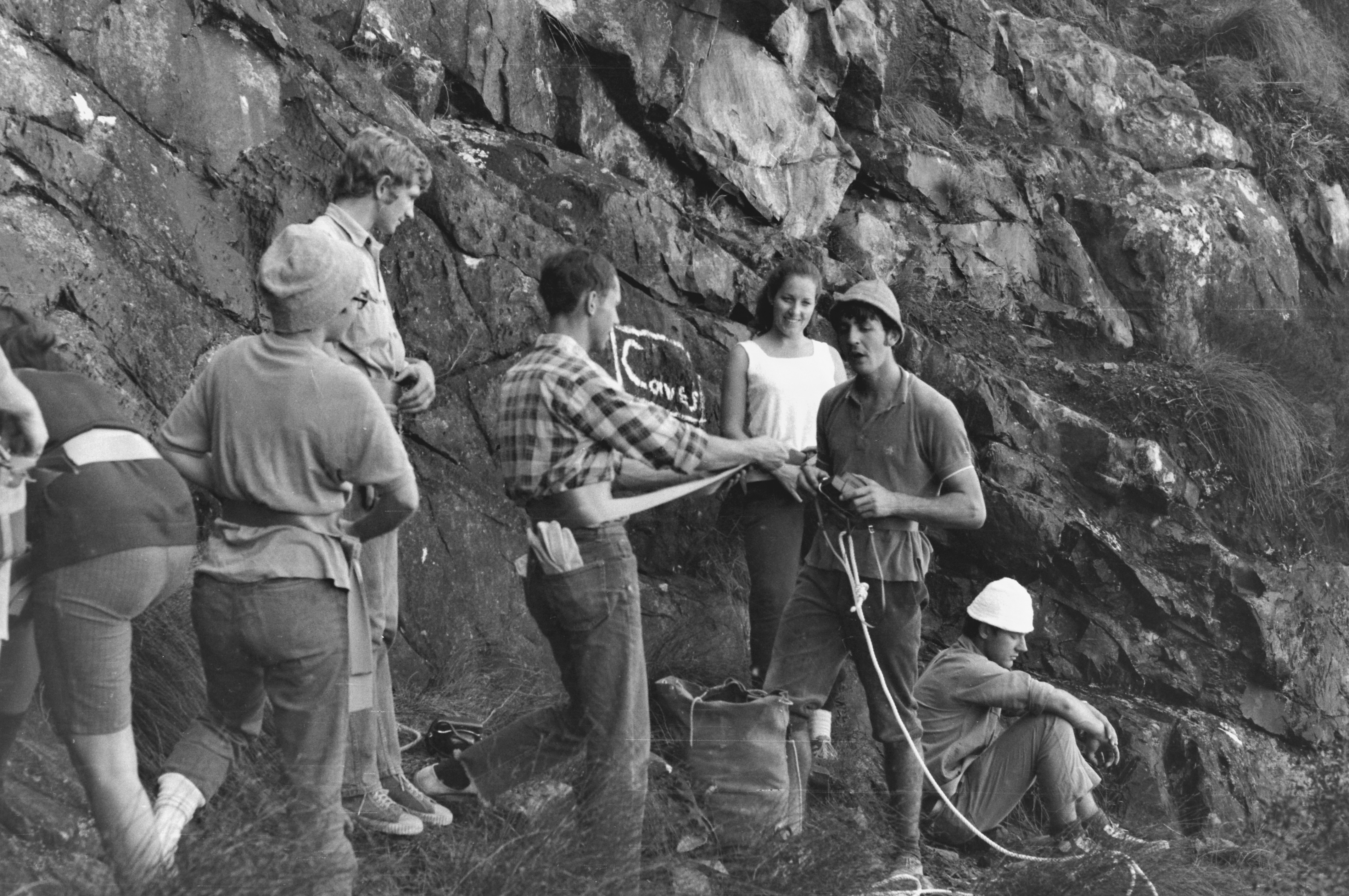
An Adventurers' Club outing on Tibrogargan in 1969 - Alan Milband (with the rope) instructs beginners
on an ascent of Caves Route (Rod Bolton collection
)


Rod abseiling on the lower slopes of Mt Beerwah in the Glass House Mountains on an Adventurers' Club excursion in 1969
(Rod Bolton collection)


Alan Milband leading boldly in Volley OCs on Tibrogargan - Adventurers' Club outing 1969 (Rod Bolton collection)

A few years later he joined the Adventurers' Club, a group of outdoors' enthusiasts who met regularly at a refurbished boathouse on the banks of the Brisbane River at Kangaroo Point. It was through this active organisation that he met Rick White who had been engaged by the club as a climbing instructor. He also met up with ex-pat Welsh climber Alan Milband and local Ian Cameron, both featuring in bold early ascents in southeast Queensland - Alan on the 3rd ascent of the East Face of Mt Barney (with Greg Sheard) and Ian on many of the early 1st ascents at Frog Buttress (with Rick White). Rod was a highly skilled photographer and worked for some years as a camera repair technician, drawing on his extraordinary engineering skills. In more recent years, both Rod and Ian joined a growing number of backyard native bee keepers with several hives of the curious little stingless insects between them.


Rod with Alan Milband on the summit of Tibrogargan in the Glass House Mountains in 1969 (Rod Bolton collection)

I reconnected with both Rod and Ian through my research for climbing history book, The living rock, and my own interest in native bees. Rod and Ian had planned a visit to my place to split one of my hives when COVID struck in 2019, grounding us all temporarily. Although I never climbed with Rod, his infectious good humour and his extraordinary attention to detail will forever stay with me. 


(from left) Alan Brown, Rick White and Rod on the summit of Coonowrin, Glass House Mountains,
probably after their 1st ascent of the climb, 'Stairs', in July 1969.

When Rod was diagnosed with aggressive pancreatic cancer a few months ago, his typically throwaway response was simply: 'Shit happens.' His experiences are emblematic of so many of us who comprise the climbing-outdoors community. All of us have lives, families and friends beyond the crags and for me, his story underlines the broad spectrum of 'ordinary' people who comprise the Australian climbing/outdoors community. The vast majority of us will never find our names aligned with terms like 'the longest', 'the hardest', or 'the best', but it explains one of the great appeals of exploring the outdoors in whatever form we choose: each of us is able to have our own unique, intensely personal experiences that can - and usually do - enrich our lives. Crossing paths with Rod has enhanced this process for many of us. 


Rod on an early ascent at Frog Buttress in 1969


Ian Cameron (belayed by Rod) searching for a suitable 'cracker' placement on the 1st pitch of Carborundum
Tibrogargan, 1969 (Rod Bolton collection)


A smiling Rod Bolton (centre rear with beanie) oversees a stretcher party carrying his friend, Alan Milband, seriously injured in a fall on Mt Barney's West Peak in 1969.
Greg Sheard (front left) leads the rescue team to glory (The Courier-Mail, Rod Bolton collection)


Saturday, May 14, 2022

TWO TRIBUTES TO WOMEN ON THE HEIGHTS

Vale Cecily Fearnley 1925-2022

The photograph (below) of local pioneering climber-bushwalker, Cecily Fearnley, was recently sent to me by a family friend and with permission, I'm posting it here. A passionate and award-winning environmentalist and museum artist, Cecily was founding vice-president of the Brisbane Bush Walkers in 1949. She passed away in January, 2022, just before her 97th birthday. I had the good fortune of meeting Cecily -- known as 'Noosa's natural living treasure' -- in 2016 at the Noosa Library when she attended a presentation I gave on local climbing history, based on my research for The living rock. I recall that she was the first to arrive and the last to leave that day and we spent time talking about her various ascents in the Glass House Mountains in the 1950s and 1960s. While it is sad that another of our pioneering women has moved on, the environmental legacy she has helped to create will remain.


Cecily Fearnley climbing in the Glass House Mountains ca. 1950 (Photo: Fearnley family)

Online acknowledgements and tributes to Cecily Fearnley:

Australian Encyclopedia for Science and Innovation 

Noosa Today 

Noosa Parks Association 


*****

History's forgotten female mountaineers...


And while on the topic of women on the heights, I've just finished reading a wonderfully illuminating study by British researcher Clare Roche on the hidden and largely ignored history of female climbers in the Alps at the end of the 19th century. As I discovered myself in researching the history of rockclimbing in Australia, women played a far more central role here -- particularly in southeast Queensland -- than had previously been acknowledged. It underlines the general sidelining or ignorance of women's achievements across a broad spectrum of society, a process that largely continues today despite the best efforts of some to challenge male dominance. The evidence for this is overwhelming for anyone who cares to look beyond the status quo (largely controlled by men) and this well-written and accessible account of women exploring the Alps is another excellent example. It takes us beyond the endless array of mountaineering publications that largely replicate each other in terms of a lack of acknowledgement of the role played by women in the development of European mountaineering. 

Who knew about the number of first ascents in the Alps by women, on occasion in advance of men? Who has heard of the pioneering female mountaineers who explored the heights at a time when Victorian era women were defined as -- and assumed to be -- 'the weaker sex'? For those with an academic and/or theoretical bent, there is much in this thesis in relation to women's agency and how middle-class Victorian women redefined perceptions of the female body through their engagement with the mountains. The overall historical narrative is uplifting and I highly recommend it to anyone who is interested in this fascinating and under-acknowledged aspect of mountaineering history.

Link to a PDF of Dr Clare Roche's thesis


Wednesday, March 09, 2022

Vale Bryden Allen

Bryden Allen 

28 February 1940 -  9 February 2022


Bryden Allen climbing Toyland (25) in the Blue Mountains in 1998 at age 58
Photograph: Simon Carter

Bryden Allen was arguably the foremost figure in postwar Australian rockclimbing, pushing the boundaries on bold new routes throughout the 1960s and 70s that today still demand the highest respect. Despite becoming paraplegic following a fall when approaching a climb at Mt Arapiles in 2000, Bryden maintained his close connection with the Sydney climbing community, often belaying from his wheelchair. One of his regular climbing partners from the early years, Keith Bell, reflects on this giant of Australian rockclimbing culture and on the extraordinary persistence and drive that Bryden refused to let interfere with his life following his accident. Read Keith's tribute to a truly eccentric and inspirational person...Bryden Allen obituary